
AS/NZS 3003 Explained: Electrical Requirements for Patient Areas
AS/NZS 3003 is the Australian and New Zealand standard for electrical installations in patient areas: the parts of hospitals, medical centres, dental practices and other healthcare facilities where electromedical equipment is used on people. This guide explains, in plain language, what the standard covers, what body-protected and cardiac-protected areas are, and what that means for the electricians and facility staff responsible for these installations.
What is AS/NZS 3003?
AS/NZS 3003 (current edition 2018, with amendments) sets out the electrical safety requirements for areas where patients may be connected to electromedical equipment. Patients are uniquely vulnerable to electric shock: they may be unconscious, have electrodes or conductive connections to their body, or have their natural resistance bypassed by medical procedures. Ordinary installation rules under AS/NZS 3000 (the Wiring Rules) are not, on their own, enough in these areas, so AS/NZS 3003 adds a layer of additional protection requirements on top.
Where does AS/NZS 3003 apply?
Anywhere low-voltage electromedical equipment is used on patients. That includes hospitals and day-procedure centres, but also many smaller facilities that are easy to overlook: general practices, dental surgeries, specialist rooms, physiotherapy and allied-health clinics, and treatment areas in aged care. If a room contains equipment that connects electrically to a patient, it needs to be assessed and classified, and the installation in it must meet the requirements for that classification.
What is a body-protected electrical area?
A body-protected area is a patient area where equipment may be electrically connected to a patient’s body through skin contact, electrodes or invasive connections that don’t reach the heart. Because current can flow through the patient more easily than through a healthy person, the standard requires additional safeguards for the electrical installation in these areas, including enhanced protection on the circuits that supply them. Typical examples include treatment rooms, dental surgeries and many general clinical areas.
What is a cardiac-protected electrical area?
A cardiac-protected area is a patient area where a direct conductive connection to a patient’s heart is possible, such as cardiac catheterisation laboratories and certain operating theatres and intensive-care areas. Even tiny leakage currents can be dangerous when there is a pathway to the heart, so the standard requires the highest level of protection here, including additional measures such as equipotential earthing arrangements beyond those required for body-protected areas.
Who decides how a patient area is classified?
Classification is decided by the facility in consultation with the people who understand how each area is actually used: clinical staff, biomedical engineers and the electrical contractor. It is the essential first step: the classification determines which of the standard’s requirements apply to the installation. Getting it wrong in either direction is costly: under-classifying creates a safety and compliance risk, while over-classifying adds unnecessary installation cost. Our Identifying Different Patient Areas course covers this classification process step by step.
What does AS/NZS 3003 require for power points, RCDs and earthing?
The standard sets out detailed requirements for the electrical installation in each class of patient area, covering things like:
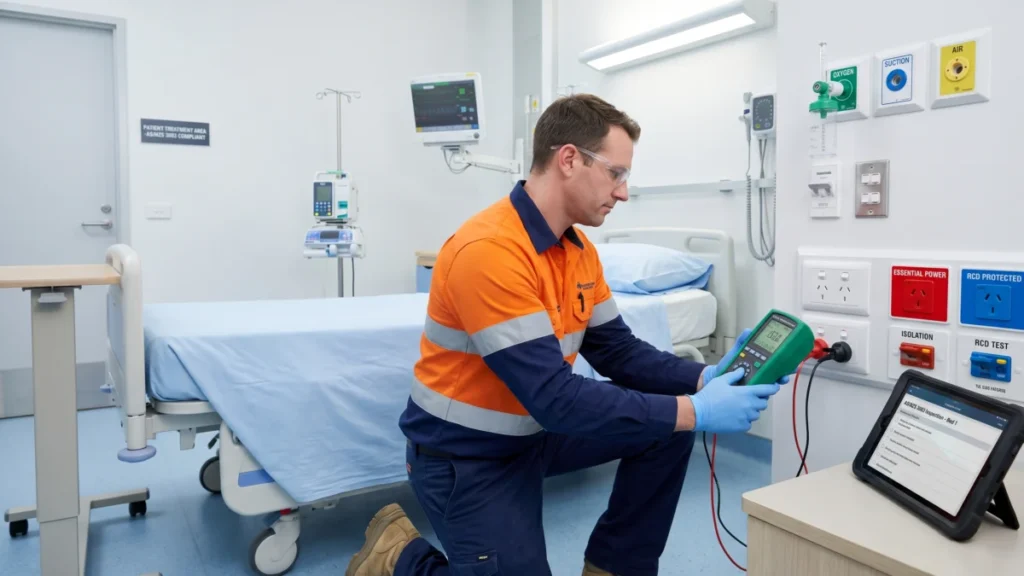
- Socket outlets: where they may be installed in a patient area and how they must be protected
- RCD (safety switch) protection: the type and arrangement of residual current protection required on circuits supplying patient areas
- Switchboards and panels: how patient-area circuits are distributed, separated and identified at the switchboard, and where panels serving patient areas may be located
- Earthing: including equipotential earthing requirements in cardiac-protected areas
- Supply arrangements, indication and alarms: how patient-area circuits are arranged and identified, and the supply-status indicators and alarms that monitor them
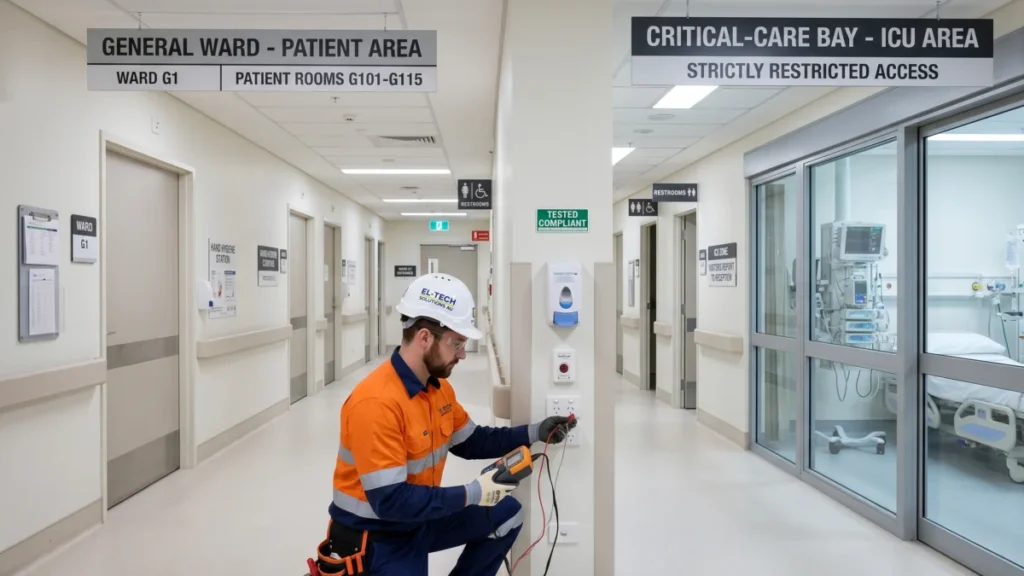
- Signage: patient areas must be identified with signage that shows their classification
The exact specifications depend on the area’s classification, and they matter. This is precisely the detail the standard exists to define, and reproducing it here wouldn’t do it justice. For the full requirements, work from the current edition of AS/NZS 3003 from Standards Australia; to learn how to apply them in practice, see our AS/NZS 3003 – Electrical Requirements for Patient Areas course.
How often do patient areas need to be inspected and tested?
Patient-area installations aren’t “install and forget.” AS/NZS 3003 requires routine inspection and testing of patient-area installations at defined intervals, with records kept, in addition to the verification required when an installation is new or altered. The testing regime sits alongside the facility’s broader obligations for medical equipment itself (covered by other standards such as AS/NZS 3551). Who performs the testing, what gets checked and how results are recorded are all part of the standard’s requirements, and a core topic in our AS/NZS 3003 course. That includes the tester themselves: patient-area testing calls for someone who understands the standard’s test methods and acceptance criteria, working with appropriately calibrated instruments.
Who can do electrical work in patient areas?
Electrical work in patient areas must be carried out by licensed electricians, and realistically by electricians who understand this standard. Work that would be perfectly compliant in a commercial fit-out can be non-compliant in a body-protected area. Facility managers and practice owners also carry responsibility: they need to know their areas’ classifications, keep signage and records current, and ensure testing happens on schedule. That’s why our training serves both audiences: the electricians doing the work and the facility staff responsible for the areas.
Frequently asked questions
What’s the difference between body-protected and cardiac-protected areas?
Body-protected areas cover situations where equipment connects electrically to the patient’s body; cardiac-protected areas cover situations where a conductive connection to the heart is possible, and require a higher level of protection, including additional earthing measures.
Does a dental practice need to comply with AS/NZS 3003?
If the practice has areas where electromedical equipment is used on patients, those areas need to be classified and the installation must meet the standard’s requirements for that classification. Dental surgeries are commonly classified as body-protected areas.
How often do patient areas need testing?
AS/NZS 3003 requires routine inspection and testing at defined intervals, with records kept, plus verification whenever an installation is new or altered. The intervals and scope are set out in the standard and depend on the installation.
Who classifies patient areas?
The facility, in consultation with clinical staff, biomedical engineers and the electrical contractor. Classification determines which requirements apply, so it’s the first step in any patient-area project.
Where can I get a copy of AS/NZS 3003?
The standard is published by Standards Australia and available from their store and authorised distributors. This page is general guidance only. Always work from the current edition.
Learn to apply AS/NZS 3003
NECA Learn offers two self-paced online courses on this standard. Start with classification, then apply the requirements:
This page is general guidance for awareness purposes. It is not a substitute for the standard itself or for professional advice. Always work from the current edition of AS/NZS 3003 and consult appropriately qualified people for your specific installation.