Technical
AS/NZS 3003 – Electrical Requirements for Patient Areas
Apply AS/NZS 3003 requirements when working on electrical systems in medical and patient-care environments.
Estimated time1 Hour
FormatOnline, self-paced
On completionCPD certificate
Course Overview
This online, self-paced course trains electricians, electrical contractors and facility staff to apply AS/NZS 3003, the standard for electrical installations in the patient areas of hospitals, medical centres and dental practices. It is set at awareness level, takes about an hour, and finishes with a short knowledge assessment and a certificate of completion recording your learning hours.
Why patient areas have their own electrical standard
Patients connected to electromedical equipment are far more vulnerable to electric shock than a healthy person: they may be unconscious, have electrodes or invasive connections, or have their natural resistance bypassed by a procedure. The ordinary Wiring Rules are not enough on their own in these rooms, so AS/NZS 3003 adds requirements for socket outlets, RCD protection, earthing, supply arrangements, signage and routine testing in body-protected and cardiac-protected electrical areas. This course teaches you what those obligations mean in practice and how to work to them day to day.
What the standard asks of you on site
The course works through the obligations an electrician meets in a classified area, including:
- Socket outlets and power points: what governs their placement and protection in a patient area
- RCDs: why patient-area circuits carry more sensitive protection than a standard fit-out, and how the arrangements differ
- Earthing: what changes in a body-protected area, and the equipotential bonding a cardiac-protected area adds
- Switchboards and panels: keeping patient-area circuits separated and identifiable at the board
- Supply indication and alarms: how patient-area supplies are monitored, and what the indicators tell clinical staff
The exact specifications depend on the area’s classification and sit in the current edition of the standard. The course covers each obligation at working level; for construction detail you always work from AS/NZS 3003 itself.
Testing, certification and records
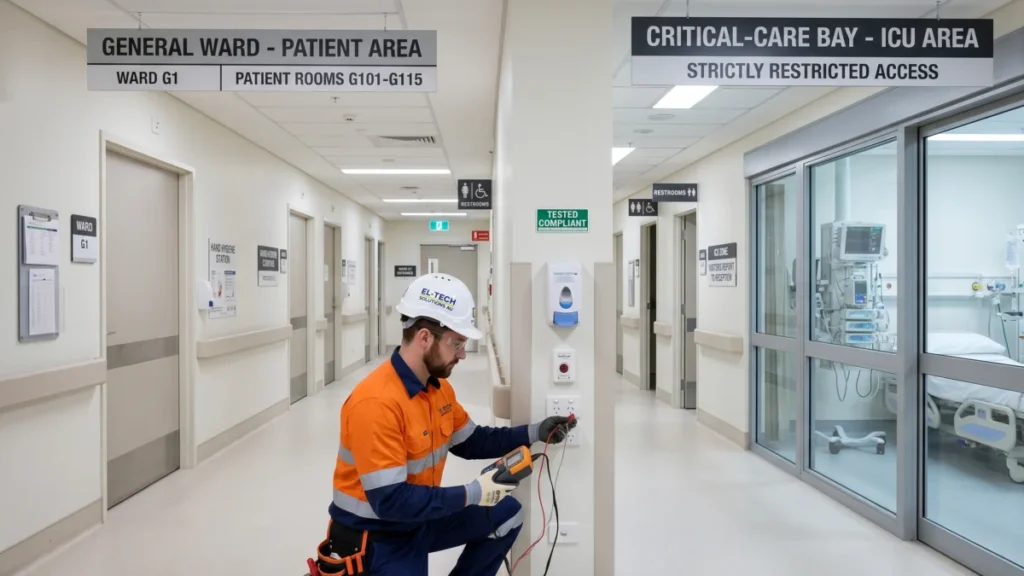
Patient areas are not install-and-forget. The standard requires verification when an installation is new or altered, then routine inspection and testing at defined intervals, with records kept. Facilities commonly run this as annual certification through a qualified tester, and the compliance label displayed with the area’s signage shows when it was last done. The course covers what gets tested, who performs it and the records a facility should be able to produce.
Who should take this course
- Licensed electricians and contractors who install, alter, repair or test electrical work in hospitals, medical and dental practices, day clinics or aged-care treatment areas
- Facility and practice managers responsible for compliant patient areas, signage, records and testing schedules
- Biomedical and estates staff who coordinate electrical work in clinical environments
Work that would be perfectly compliant in a commercial fit-out can be non-compliant in a body-protected area. If healthcare sites are part of your work, this standard is part of your job. The course suits both first-time awareness and refresher use.
Your patient-areas training pathway
Classification comes first: the requirements that apply depend on whether an area is body-protected or cardiac-protected, so pair this course with Identifying Different Patient Areas to learn the classification step. New to the standard entirely? Start with our plain-language guide, AS/NZS 3003 Explained, then come back and put it into practice here.
What You’ll Learn
Understand how AS/NZS 3003 applies to electrical installations in patient areas of medical and dental facilities
Recognise the difference between body-protected and cardiac-protected patient areas
Identify the additional electrical safety measures required where patients connect to electromedical equipment
Describe the electrical requirements for installing and maintaining equipment in patient areas
Apply the basics of AS/NZS 3003 awareness when working in healthcare electrical settings
What’s Included
Self-paced online module
Knowledge assessment
Certificate on completion
Approx. 1 Hour
Records CPD hours
Records your CPD hours
On completion you’ll receive a certificate recording your CPD hours, ready to add to your professional development record.
Training a team?
Buy 2 or more seats and your company group is set up automatically.
One link for your whole team - Share it (or the QR code) and each person is enrolled as they join.
Everyone registers as themselves - Each certificate is issued in the learner’s own name.
You see everyone’s progress - Your purchase makes you the group manager.
Need more seats later - Buy the same course again and they’re added to your existing group.
Frequently Asked Questions
What is AS/NZS 3003?
AS/NZS 3003 is the Australian/New Zealand standard for electrical installations in patient areas of medical and dental facilities. It sets the additional electrical safety requirements needed where patients are connected to electromedical equipment.
What does this course cover?
Identifying and classifying patient areas, the electrical safety requirements that apply to them, and how to carry out compliant electrical work in medical and dental facilities.
Who should do this training?
Electricians, electrical contractors and facility staff who work on or maintain healthcare electrical installations.
Can I do this course online?
The course is online and self-paced through NECA Learn, so an electrician can complete it before starting on a healthcare site rather than waiting for a scheduled session.
Does this course count toward my CPD or licence renewal?
This course records self-paced professional development, with a certificate of completion documenting your learning. It is not represented as an approved licence-renewal or skills-maintenance course. Renewal requirements are set by your state or territory regulator; see our state-by-state electrician licensing guide and confirm what applies to your licence before relying on any course for renewal.