BusinessSafety
Managing Mental Health in Construction
Spot the risks on site and at home, read the warning signs and build your own PACE plan.
Estimated time1 Hour
FormatOnline, self-paced
On completionCPD certificate
Course Overview
Work health and safety law treats the things that damage mental health on a construction site the same way it treats falls, electricity and dust: the business has to find them, remove the risk where it can and reduce what is left. This online, self-paced course for construction workers and supervisors covers how to spot those hazards and the pressures that follow people in from home, how to tell when a workmate is starting to struggle, and how to look after your own mental health with the PACE habits (Pause, Act, Connect, Enjoy). It is awareness training, not counselling or clinical training.
The risks, on site and off it
The first half of the course is about where the risk comes from. It opens with the three kinds of psychosocial hazard you see most on a site: bad working relationships, including bullying, harassment and aggression from anyone, supervisors included; badly organised work; and unsafe conditions. A lesson on substance use follows the loop where a drink or a smoke takes the edge off a rough patch and then makes the underlying problem worse. Then come the pressures outside work that do the most damage: isolation, money worry, work crowding out everything else, and the effects of past trauma. The last risk lesson is about warning signs: the changes in mood, behaviour, appearance and work that show someone is in trouble, how to tell a bad day from a pattern, and how to keep an eye on a workmate without it turning into surveillance.
PACE: four habits that hold up on a working week
The second half is the PACE framework, which Beyond Blue publishes as a free app so you can keep using it after the course. Pause is for the moment something has got on top of you: controlled breathing, a short mindful break, getting the worry out of your head and onto paper. Act lowers the baseline over time: exercise that fits your fitness and your shifts, sleep and food, alcohol-free days. Connect covers the R U OK? conversation in four steps (ask, listen, encourage action, check in) and building a support network across family, work and the community that runs both ways. Enjoy is about putting the things that restore you in the diary before work takes the space. The course ends with you drafting a personal wellbeing action plan: what goes in it, a schedule you can keep and how to tell whether it is working.
What you leave with
On completion you receive a certificate of completion and a signed training record listing the topics covered. You also leave with the numbers worth keeping in your phone: MATES in Construction, Lifeline, Beyond Blue and 13YARN, all open 24 hours a day, and the reminder to call 000 if someone is in immediate danger. If alcohol or drugs on site are the bigger concern for your crew, pair this course with Drugs and Alcohol in Construction. For the hazards side, what the business must do about workload, rosters, bullying and trauma, see Psychosocial Hazards Awareness.
What You’ll Learn
Recognise mental health as a work health and safety issue, the psychosocial hazards that arise on a construction site and what the law requires of employers and workers
Recognise bullying, harassment, aggressive behaviour and violence as psychosocial hazards, including when the conduct comes from a supervisor
Understand the two-way relationship between substance use and mental health, and how alcohol and drugs affect mood and anxiety
Recognise the risks that come from outside work (isolation, money pressure, work-life imbalance and past trauma) and the mood and behaviour warning signs of distress in a workmate
Describe the PACE framework (Pause, Act, Connect, Enjoy) and apply Pause and Act strategies such as controlled breathing, mindful breaks and physical activity
Apply Connect and Enjoy strategies, build a support network across family, work and community, and use exercise for mental wellbeing
Create a personal mental wellbeing action plan with a realistic schedule, a way to monitor it and measures to keep it going
What’s Included
Self-paced online module
Knowledge assessment
Certificate on completion
Approx. 1 Hour
Records CPD hours
Records your CPD hours
On completion you’ll receive a certificate recording your CPD hours, ready to add to your professional development record.
Training a team?
Buy 2 or more seats and your company group is set up automatically.
One link for your whole team - Share it (or the QR code) and each person is enrolled as they join.
Everyone registers as themselves - Each certificate is issued in the learner’s own name.
You see everyone’s progress - Your purchase makes you the group manager.
Need more seats later - Buy the same course again and they’re added to your existing group.
Frequently Asked Questions
Why is mental health treated as a safety issue on site?
Because work health and safety law treats psychosocial hazards the same way as physical ones. The business has to identify them, remove the risk where it can and reduce what is left so far as is reasonably practicable. Bullying, harassment, violence, low job control, high job demands, poor support and exposure to traumatic events all sit under that duty, and the course opens with it.
What is the PACE framework?
Four everyday habits from Beyond Blue. Pause is rest, self-care, self-talk and mindfulness for the moment stress has got on top of you. Act is exercise, routine and less alcohol, which lower the baseline over time. Connect is contact with people that does not wait for anyone to feel like it. Enjoy is time, in the diary, for the things that restore you. Beyond Blue publishes PACE as a free app, so it keeps working after the course.
How do I tell a bad day from a real problem?
By how long it lasts and whether it forms a pattern. Temporary stress lasts days to a few weeks, eases once the stressor is sorted and barely touches work. Sustained decline lasts beyond several weeks, does not improve on its own, shows up in work and appearance, and often comes with alcohol or drugs as the way of coping. The course uses one week in the life of a second-year sparky to practise reading the difference.
What should I say to a workmate who seems off?
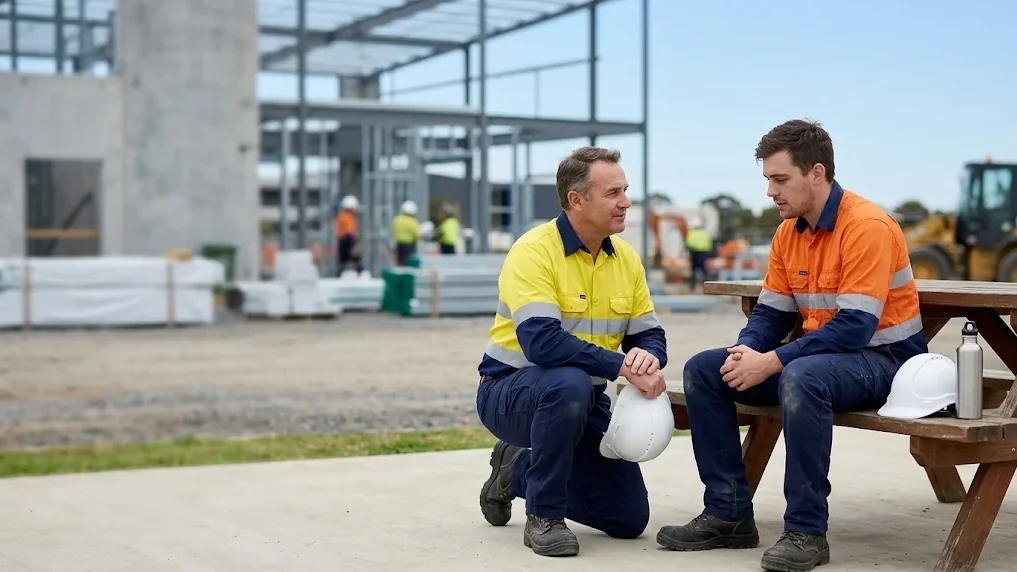
The course teaches the R U OK? steps. Pick the moment, the ute rather than the smoko room, say what you noticed and ask straight. Listen without jumping to a fix. Ask what would help and point to one next step. Then put a time on the follow-up and keep it. If someone is in immediate danger, call 000. MATES in Construction (1300 642 111) and Lifeline (13 11 14) answer 24 hours a day.
Can I do this training online?
Yes. The module runs in your browser at your own pace, with short knowledge checks through it and a knowledge assessment at the end, and you can stop and come back at any point. The estimated time is one hour.
Does this course count toward my CPD or licence renewal?
This course records self-paced professional development, with a certificate of completion documenting your learning. It is not represented as an approved licence-renewal or skills-maintenance course. Renewal requirements are set by your state or territory regulator; see our state-by-state electrician licensing guide and confirm what applies to your licence before relying on any course for renewal.